
There may be no more misunderstood concept in golf instruction than swing plane.
Golfers are constantly told to get the club “on plane,” to “shallow the club,” or to get the shaft into a particular position. But these instructions often leave golfers focused on positions rather than understanding why swing plane matters in the first place.
My philosophy is simple:
The goal isn’t to make every golfer swing on the same plane. The goal is to organize the movement of the golf club so that the club remains balanced and can be delivered efficiently to the golf ball.
Swing plane is one of the ways we evaluate whether that is happening.
What Is Swing Plane?
The golf club doesn’t simply move along a two-dimensional line.
During the golf swing, the club is simultaneously:
- Moving vertically—up and down.
- Moving closer to and farther from the golfer.
- Moving toward and away from the target.
- Pivoting through space.
- Rotating around the shaft’s axis.
Swing plane is the result of these movements working together. That is why I don’t view swing plane as a single line that the club must stay on from address to impact. Instead, I establish a reference plane at address and then evaluate the club’s relationship to that plane at key points in the golf swing.
Those checkpoints are:
Address → P3 → P5 → Impact
It Starts at Address
At address, the shaft is inclined relative to the ground. That creates a natural geometric relationship between the clubhead, the hands, the ground, and the golfer’s body. I use the shaft’s angle at address to establish the golfer’s original shaft plane. That becomes our reference.
From there, we’re not trying to force the club to remain on that exact line throughout the entire swing. We’re evaluating whether the club is maintaining an appropriate relationship to that reference as it moves through three-dimensional space.
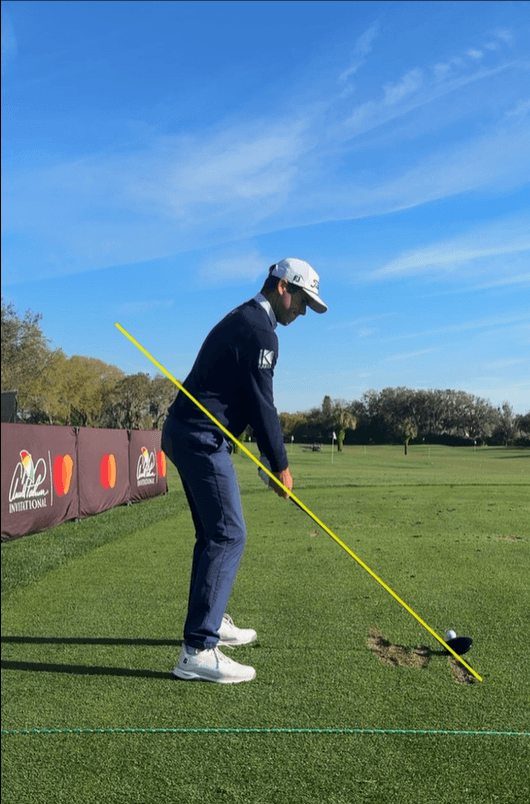
The Club Has to Be in Balance
This is the foundation of my swing-plane philosophy.
The club has to be in balance.
Think about a cargo airplane. When cargo is loaded, the weight has to be distributed appropriately so the airplane can operate efficiently.
Think about a cargo ship. The load has to be distributed so the ship remains stable as it moves through the water.
Or think about a track runner. If the runner isn’t organized and balanced while accelerating out of the blocks, they’re not going to produce their best time.
The golf swing is no different. The golfer is trying to accelerate a golf club that has mass.
If the club gets into a position where the golfer has to fight its weight, redirect it, or make compensations to get it back to the golf ball, the movement becomes less efficient. That can affect speed, consistency, contact, and accuracy. This is why I often tell golfers to “get the club in balance.”
A balanced club should feel relatively light rather than something the golfer has to fight.
As the club moves back, I want the golfer to establish a good relationship with the original shaft plane.
Through approximately the 8 o’clock position, I prefer the club to stay along that original shaft plane.
From there, the club begins to hinge and move upward.
By P3—the lead arm approximately parallel to the ground—the shaft should be approximately parallel to the original shaft plane or slightly steeper.

If the golfer gets under the plane during the takeaway, the club can become laid off and feel heavy at P3. The golfer may have difficulty getting the club high enough, and the shoulders and arms can become restricted.
From there, the golfer may instinctively compensate by throwing the club outward in transition, producing the familiar over-the-top or outside-in delivery.
The opposite can happen when the golfer creates too much height and not enough depth.
Now the golfer has reduced the horizontal space available to the club. The club can become excessively steep, and the golfer may have to make another compensation to get the club back to the ball. The point is not that “steep” is automatically bad or “shallow” is automatically good.
The point is that height and depth have to balance out and work together.
P5: Returning the Club to Plane
The next important checkpoint is P5—the lead arm approximately parallel to the ground during the downswing.
Here, I want the shaft to be above and parallel to the original shaft plane established at address.
This is an important distinction.
The shaft does not need to be sitting directly on the original plane. It should be in an appropriate parallel relationship to it. When it is, the club is in a balanced position from which it can continue toward impact. This is also where I believe the modern emphasis on “shallowing” can create confusion.

The word “shallow” has become one of the most popular terms in golf instruction.
But it is often misunderstood.
There are three basic ways a golfer can organize the club in the backswing and return it in the downswing:
On → On
The club goes back on the reference plane and returns on that plane.
Above → On
The club goes back above the reference plane and returns to it.
Under → On
The club goes back underneath the reference plane and returns to it. All three patterns have been successfully used by elite golfers. Hank Haney’s parallel-plane concept with Tiger Woods is an example of an on-to-on relationship. Jim Furyk is an excellent example of a golfer who takes the club back significantly above the reference plane and returns it to plane. Bruce Lietzke demonstrated that a golfer can take the club back underneath the reference plane and still return it effectively.
This tells us something important:
There isn’t one backswing plane that every golfer must use.
For the average golfer, however, I generally recommend taking the club back on plane or slightly above it. It provides a simpler and more repeatable geometry for returning the club to the ball. And that’s where I strongly disagree with the way “shallowing” is often taught. The goal isn’t to get the club underneath the plane. Which is what I see a lot from golfers who over do the term "shallow."
The goal is to get the club back to plane.
If a golfer is excessively steep, they may need to change the club’s orientation in transition. But that doesn’t mean the club needs to be dumped underneath the plane. A golfer who learns to “shallow” by simply letting the shaft fall behind them can create an entirely different problem. They introduce a pattern that causes the hands to roll and flip through impact.
Instead of:
Steep → Shallow
the objective should be:
Organize → Return to plane → Deliver
The Geometry of the Golf Swing
There is another reason the original shaft plane is so useful. Think of the shaft at address as the hypotenuse of a triangle. The shaft has both a vertical and horizontal component. That relationship helps explain why the golfer’s relationship to the ball matters so much. If the golfer moves closer to the ball coming into impact, the horizontal component of the triangle becomes shorter. For the club to still reach the golf ball, the vertical component must increase. In other words, the geometry changes. The shaft becomes steeper. This is why swing plane cannot be separated from the golfer’s movement and their relationship to the golf ball. The club isn’t operating in isolation.
The golfer and the golf club are one moving system.
Impact: Return as Close to the Original Plane as Possible
At impact, I want the shaft to return as close as possible to the original shaft plane established at address.
Why?
Because the clubface is an inclined surface because of its loft. If the handle gets excessively high at impact, the orientation of the inclined clubface changes. That can alter the direction the face is pointing and influence launch direction and spin-axis tilt.
So while there is certainly individual variation in how golfers deliver the club, returning the shaft as close as practical to the original shaft plane provides a more predictable relationship between the golfer, the shaft, and the clubface.
The objective isn’t to hit some perfect visual position.
The objective is to create a repeatable and functional delivery.
The Three-Dimensional Swing
This is ultimately why I believe swing plane should be taught differently. The golf swing isn’t a flat, two-dimensional motion.
The club is moving:
Up and down.
In and out.
Toward and away from the target.
Pivoting.
Rotating.
All of those movements occur simultaneously.
So rather than asking:
“Is my club on the plane?”
I think a better question is:
“Is the club organized in a way that allows me to deliver it efficiently?”
That brings us back to the foundation:
Balance.
When the club is appropriately balanced, the golfer doesn’t have to fight the club.
When the club is appropriately related to the original shaft plane, the golfer has a better geometric opportunity to return the club to the ball efficiently.
And when the club is delivered efficiently, the golfer has a better opportunity to produce what every golfer ultimately wants:
Speed.
Accuracy.
Consistency.
And solid contact.
My Philosophy of Swing Plane
I don’t believe there is one perfect swing plane. I believe there is an appropriate relationship between the golfer, the golf club, and the plane established at address. I use four checkpoints to evaluate that relationship:
Address: Establish the reference plane.
P3: Evaluate the club’s relationship to the original plane and its balance.
P5: Return the shaft to a parallel relationship with the original plane.
Impact: Return the shaft as close as practical to the original plane for a predictable delivery.
The golfer doesn’t need to copy Tiger Woods, Jim Furyk, Bruce Lietzke, or anyone else.
They need to learn how to organize their golf club.
And that’s why I don’t teach golfers to chase a particular swing-plane position.
I teach them to get the club in balance, understand its geometry, and return it to plane.
Want to Know If Your Swing Is on Plane?
Understanding swing plane is one thing. Knowing whether your own swing is actually on plane is another.
If you're unsure whether your club is getting too far inside, too far above, or returning to the proper plane in the downswing, I'd be happy to take a look.
Send me your swing, and I'll analyze the key positions and movements we discussed in this article—including your relationship to the original shaft plane, P3, P5, and impact.
Sometimes the best way to understand what you're doing is to have someone show you exactly what is happening in your own swing.
